Patients and families
Functional neurological disorder
What FND is, how it is recognized, and what helps: rehabilitation, pacing, and ways to come back to the present moment.
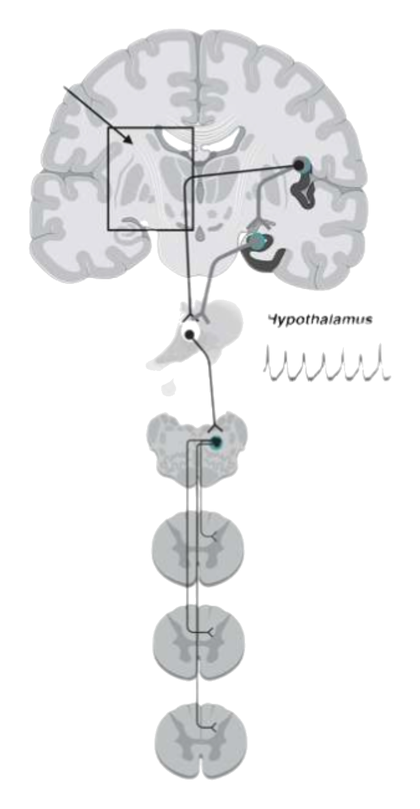
Functional neurological disorder (FND) occurs when the nervous system functions in an altered way: the brain and the body send and receive signals out of order. The symptoms are real. They can limit life as much as those of another neurologic disease. You are not alone. Early treatment is the most favorable, and improvement is still possible when symptoms have lasted a long time.
What it is, and who it affects
FND sits within a wider group of functional disorders, which can affect other body systems. It is a problem of function, not a structural injury seen on a scan or a blood test. That is why the diagnosis is not made by tests alone: it is made by finding characteristic signs on examination.
- It is about as common as multiple sclerosis or Parkinson’s disease, and one of the most frequent reasons for a neurology visit after headache.
- It can affect anyone. It is less common under age 10 and more frequent in women than in men, about 2 to 1.
- It is a positive diagnosis, not merely “what is left after everything else was excluded.”
- Treatment helps many people, not everyone. Self-management is part of care.
- It can occur together with a dysautonomia, for example vasovagal syncope or POTS. An FND diagnosis should not stop treatment of that other condition.
Why it happens
There is not a single cause. The central point is that signals become disordered or are misread, and the body acts in ways the person cannot stop at will. Studies show the symptoms are not feigned.
An injury, an infection, a panic attack, or a migraine can trigger the first symptoms. Even after that problem settles, the pattern can stay “learned.” Some people see a link with stress, anxiety, or depression. Many others do not recognize a psychological factor, and that does not undo the diagnosis.
Frequent symptoms
- Movement: weakness, tremor, spasms, jerks, speech difficulty, or paralysis of an arm or a leg.
- Sensation: vision loss, double vision, numbness, or tingling.
- Awareness: functional (non-epileptic) seizures, a feeling of fading, or fainting.
A new symptom is not automatically functional. It should be assessed on its own features.
How it is diagnosed
The clinician looks for positive signs and, when needed, tests to see whether another cause explains the picture better, for example stroke or multiple sclerosis. Ask which signs were found in your case. Motor signs include Hoover’s sign in a weak leg, downward drift of the arm without the pronation typical of a structural lesion, certain fixed postures, and patterns of the face or tongue. In tremor, copying a movement the clinician makes can improve it for a moment. In non-epileptic seizures, combinations such as closed eyes, long duration, or side-to-side head movements are sought.
Treatment
It works best when therapies are combined according to the symptoms. Not everyone recovers fully. If FND is chronic, the goal is independence and quality of life. The sooner treatment starts after diagnosis, the greater the chance of improvement usually is.
- FND-specific physical therapy, sometimes one session and sometimes a longer plan.
- Speech therapy and occupational therapy, if speech or daily activities are affected.
- Psychotherapy, for example cognitive behavioral therapy, especially for functional seizures.
- Medicines only for associated symptoms, such as pain, low mood, or anxiety. There is no drug that cures FND itself.
- Rehabilitation aims to retrain movement: unlearn the abnormal pattern and relearn the usual one, raising activity gradually.
Coming back to the present
Grounding skills help you calm or activate the nervous system on purpose. Practice them in a quiet place before you need them in a crisis.
- Hearing: music. Touch: a cold object or a smooth stone. Smell: a scent. Taste: something sour. Sight: name what is around you.
- Clench and release a fist, cold water on the hands or face, the alphabet backward, counting backward, or the words of a song.
- Return to the breath.
Balancing activity and rest
- Find your baseline: what you can do regularly without symptoms getting worse.
- Short, regular rests. During a rest, body and mind should actually let go.
- Do not try to make up on a good day for everything you missed. Overdoing it often brings a setback.
- Prioritize. It may not be possible to do everything you did before.
- Increase a little at a time: one small task or a few more minutes, and watch the effect.
At Dysautonomia Center Santa Fe, FND is evaluated together with dysautonomias and movement disorders, with the family included in the explanation. Visits can be in person or virtual.
References
- Alberto J. Espay, Selma Aybek, Alan Carson, Mark J. Edwards, Laura H. Goldstein, Mark Hallett, Kathrin LaFaver, W. Curt LaFrance Jr, Anthony E. Lang, Tim Nicholson, Glenn Nielsen, Markus Reuber, Valerie Voon, Jon Stone, Francesca Morgante. Current concepts in diagnosis and treatment of functional neurological disorders. JAMA Neurology. 2018;75(9):1132-1141. doi:10.1001/jamaneurol.2018.1264.
- Diego Kaski, Adolfo M. Bronstein, Mark J. Edwards, Jon Stone. Cranial functional (psychogenic) movement disorders. Lancet Neurology. 2015;14(12):1196-1205. doi:10.1016/S1474-4422(15)00226-4.
- Yadira Velazquez-Rodriquez, Brooke Fehily. Functional neurological disorder: historical trends and urgent directions. Journal of Neurology Research. 2023;13(1):12-32. doi:10.14740/jnr754.